Mailchimp Pricing 2026: What You’ll Actually Pay (It’s More Than the Website Shows)
Mailchimp’s pricing page shows $13/month. Your invoice will probably show more.
That gap — between what Mailchimp advertises and what you actually pay — is what this guide is about. In 2026, the difference matters more than ever. Mailchimp changed its pricing twice in the first four months of 2026 alone: in January, the free plan was cut from 500 contacts down to just 250, with monthly sends halved to 500. Then in April, legacy account holders were hit with an 11–13% price increase. Retainful
Neither change was a surprise to anyone watching the pattern. Since Intuit acquired Mailchimp for $12 billion in 2021, the free plan has dropped from 2,000 contacts in 2022, to 500 in 2023, to 250 today — an 87.5% reduction in four years. Paid plan prices rose 20–30% over that same period. Marketer’s Choice
The listed plan price is still only part of the story. Between unsubscribed contacts counting toward your limit, SMS and transactional email costs stacking on top, and overage charges, actual monthly spend commonly runs 20–40% higher than the advertised plan price. Retainful
This guide covers all of it. We’ll break down every plan with real numbers at real contact counts, surface every hidden fee, give you a calculator to find your actual cost, and tell you plainly whether Mailchimp is still worth it in 2026 — or whether you’re paying a legacy tax on a platform that has moved on without you.
What you’ll find here:
- Every plan’s real cost at your contact count (not just the starting price)
- The 2026 price changes, explained and dated
- Hidden fees most people don’t discover until they get the bill
- An interactive calculator: enter your list size, get your number
- A plain verdict: who should stay, and who should leave
Prices on this page were verified against Mailchimp’s official US pricing page in June 2026.
How Much Does Mailchimp Cost in 2026?
If you’re comparing email marketing tools, the short answer is: Mailchimp pricing in 2026 depends on your contact count, feature tier, and billing cycle.
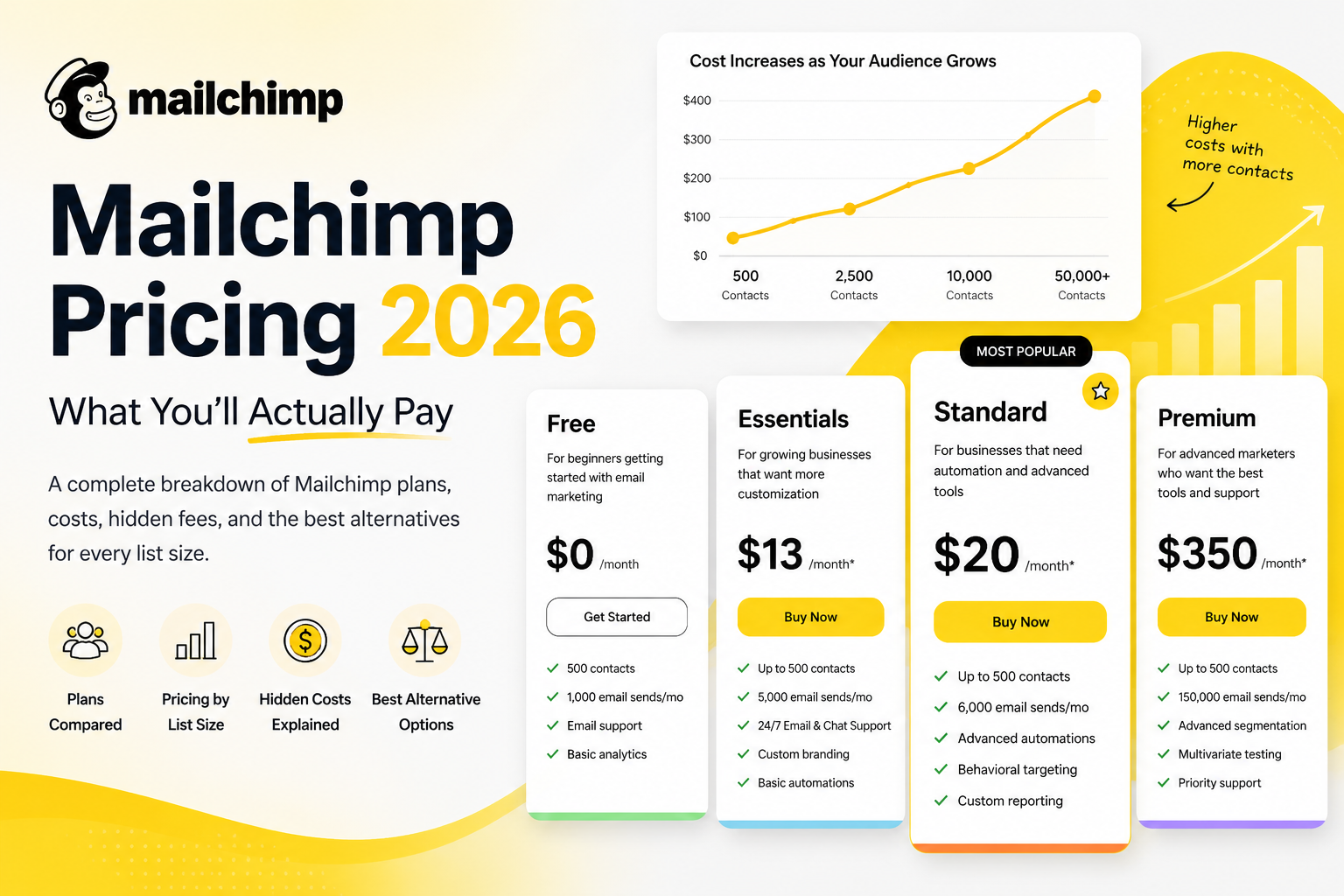
Mailchimp Pricing 2026 at a Glance
Starting prices for each Mailchimp plan. Your actual cost may be higher depending on your contact count and add-ons.
| Plan | Starting Price |
|---|---|
| Free | $0/month |
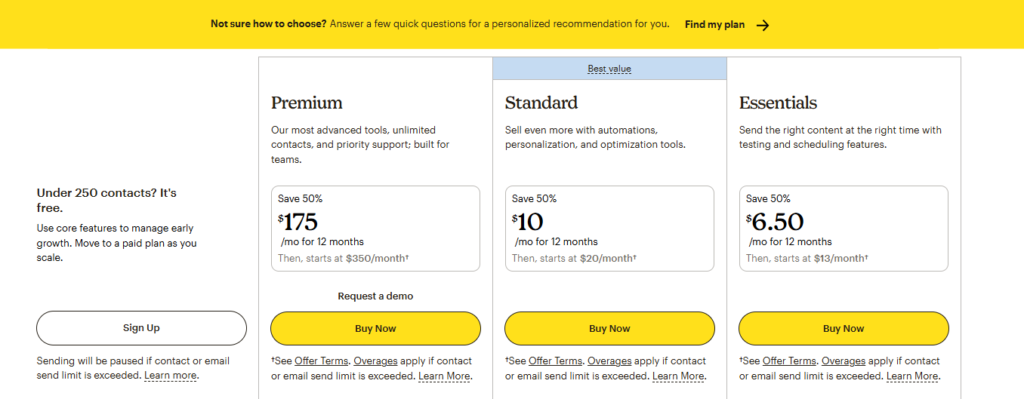
| Essentials | Starts at $13/month |
| Standard | Starts at $20/month |
| Premium | Starts at $350/month |
What most people actually pay
The biggest pricing factor is contacts stored in your audience. A business with 500 contacts may stay near the advertised starting price. A business with 10,000+ contacts often pays several times more.
In practice, many users underestimate costs because Mailchimp charges based on audience size, not just emails sent. As your list grows, monthly pricing increases even if your sending frequency stays similar.
Example: A Small Business Estimate
How Mailchimp costs typically change as your email list grows.
The Fastest Way to Estimate Your Mailchimp Cost
Use your total active contacts, not just subscribers who open emails.
Select the lowest plan that includes the features you actually need.
Include SMS marketing, transactional email, websites, or other add-ons.
Check monthly versus annual pricing before making a decision.
Important Pricing Caveat
“`The price displayed on Mailchimp’s pricing page is usually an entry-level starting price based on a small contact tier. Your actual Mailchimp pricing in 2026 can be significantly higher once you enter your real audience size and enable additional services.
“`One-sentence takeaway: For most businesses, Mailchimp pricing in 2026 is less about the advertised plan name and more about how many contacts you store and which add-ons you enable.
What You’ll Actually Pay: Mailchimp’s 2026 Pricing Changes Explained
One of the biggest mistakes new Mailchimp users make is assuming they’ll pay the price shown on the pricing page.
In practice, Mailchimp Pricing 2026 is heavily influenced by your contact count. The advertised monthly price is simply the entry point. As your audience grows, your monthly bill can increase much faster than expected.
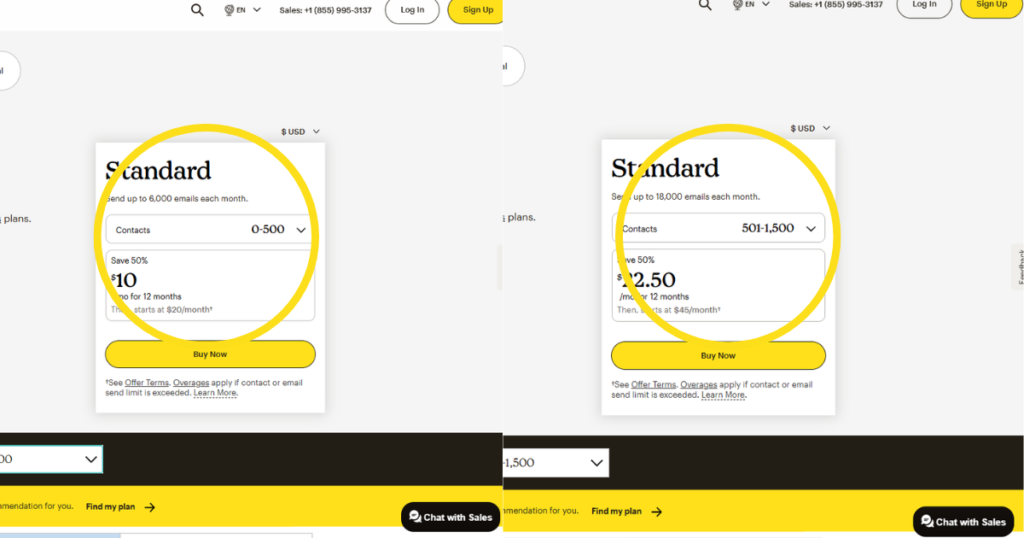
After reviewing Mailchimp’s pricing structure and comparing it with competing email marketing platforms, the biggest cost driver is almost always the size of your subscriber list—not the number of emails you send.
Mailchimp Uses Contact-Based Pricing
Mailchimp charges based on the number of contacts stored in your account.
This sounds straightforward until your list starts growing.
For example, a business with 500 subscribers may stay close to the plan’s starting price. However, a business with 10,000 or 25,000 contacts can end up paying several times more for the same plan and features.
This pricing model works well for small lists but becomes a significant factor when forecasting long-term marketing costs.
Audience Growth Often Triggers Price Increases
Most businesses focus on growing their email list.
The challenge is that every successful growth campaign can also increase software costs.
A jump from 2,500 contacts to 10,000 contacts doesn’t just improve your reach—it can move you into a much higher pricing tier.
How Mailchimp Costs Typically Grow With Your Audience
Mailchimp pricing is primarily based on contact count. As your audience grows, your monthly costs usually increase as well.
Before choosing a plan, estimate where your subscriber count will be six to twelve months from now, not where it is today.
Doing so provides a more realistic picture of your future Mailchimp expenses.
The Advertised Price Isn’t Always the Final Price
The plan price shown on Mailchimp’s website typically covers the core platform.
Depending on your marketing strategy, you may also pay for:
- SMS marketing
- Transactional emails
- Additional contacts
- Website features
- Premium support options
These costs are easy to overlook during the signup process but can noticeably increase your monthly spend over time.
Monthly vs Annual Billing
Mailchimp offers both monthly and annual payment options.
Businesses planning to use the platform for the long term should compare both billing methods before subscribing.
While annual billing can reduce overall costs, it’s important to calculate the total expense based on your expected contact growth, not just your current audience size.
What Most Businesses Actually End Up Paying
In our experience reviewing email marketing software, businesses rarely stay at the advertised starting price for long.
A growing list, additional marketing channels, and advanced automation features typically push users into higher spending tiers within the first year.
That’s why evaluating Mailchimp Pricing 2026 requires looking beyond the headline price and calculating your expected costs based on real subscriber growth.
Bottom Line
The most important change to understand about Mailchimp Pricing 2026 is that your costs scale with your audience.
If your email list is growing steadily, plan for future pricing tiers rather than today’s introductory rate.
Doing this upfront helps avoid unexpected costs and makes it easier to compare Mailchimp against alternatives that use different pricing models.
Calculate Your Real Mailchimp Cost
The biggest mistake people make when evaluating Mailchimp Pricing 2026 is looking only at the advertised monthly price.
That number rarely reflects what a growing business will actually pay.
To estimate your real Mailchimp cost, you need to consider more than just the plan itself.
Step 1: Count Your Total Contacts
Mailchimp pricing is primarily based on the number of contacts stored in your account.
Before comparing plans, determine how many active contacts you currently have.
If your list is growing every month, use your projected contact count for the next 6–12 months rather than today’s number.
This provides a more realistic cost estimate.
Step 2: Choose the Features You Actually Need
Not every business needs advanced automation, AI tools, SMS marketing, or premium support.
Start by identifying the features your business will actively use.
Paying for features you don’t need is one of the easiest ways to overspend on email marketing software.
Step 3: Factor in Additional Costs
The base subscription may not be your final monthly expense.
Depending on your marketing strategy, additional costs can include:
- SMS marketing
- Transactional emails
- Website hosting
- Premium support
- Extra contacts beyond your current pricing tier
These add-ons can significantly increase your total spending over time.
Step 4: Estimate Future Growth
When reviewing Mailchimp Pricing 2026, focus on where your audience will be in the future.
For example:
- 500 contacts today
- 2,500 contacts in six months
- 10,000 contacts next year
Many businesses budget for current pricing but fail to account for audience growth.
As a result, their email marketing costs become much higher than expected.
A Simple Cost Estimation Formula
A practical way to estimate your future Mailchimp expenses is:
Monthly Plan Cost + Add-On Costs + Future Contact Growth = Estimated Monthly Spend
This approach is not perfect, but it is far more accurate than relying on the advertised starting price alone.
Real-World Example
Imagine a small business with 2,500 contacts.
The owner chooses a paid Mailchimp plan and later adds SMS marketing and transactional email functionality.
Six months later, the list grows to 10,000 contacts.
At that point, the business is no longer paying the original starting price. The total monthly cost is likely much higher because both contact count and additional services have increased.
This is why experienced marketers evaluate total ownership cost rather than headline pricing.
Bottom Line
To calculate your real Mailchimp cost, look beyond the plan price.
Consider your contact growth, required features, and potential add-ons.
Doing this before you subscribe provides a more accurate estimate and helps you determine whether Mailchimp remains the best value compared to alternative email marketing platforms.
Mailchimp Pricing Plans Compared: Free, Essentials, Standard & Premium
Choosing the right Mailchimp plan depends on your business size, subscriber count, and marketing goals.
Get Started With Email Marketing
Ideal for testing Mailchimp and learning the platform before investing in a paid plan.
For Growing Small Businesses
Adds more templates, higher sending limits, and additional support options.
Advanced Automation & Growth
Includes customer journeys, advanced automation, and growth-focused marketing tools.
Enterprise-Level Marketing
Provides advanced segmentation, larger contact limits, and enterprise capabilities.
Expert Insight
For most businesses, the Standard plan offers the best balance of automation, scalability, and value. The Free plan works well for testing, while Premium is generally better suited to large teams with advanced requirements.
Hidden Mailchimp Fees Most Users Miss
When comparing Mailchimp Pricing 2026, don’t focus only on the advertised monthly price.
Many users discover additional costs after their account starts growing.
Common extra expenses include:
- SMS marketing credits
- Transactional email services
- Higher contact tiers
- Website and commerce features
- Premium support options
The biggest hidden cost for most businesses is audience growth. As your contact count increases, your monthly bill can rise significantly even if you stay on the same plan.
Before choosing a plan, estimate your future subscriber count and any add-on services you may need. This provides a more accurate picture of your real Mailchimp costs and helps avoid unexpected charges later.
Mailchimp Websites & Transactional Email Pricing
Mailchimp offers more than email marketing.
Businesses can also use Mailchimp for website creation and transactional email services, both of which can increase your overall costs.
Mailchimp Website Pricing
Mailchimp includes website-building tools that allow businesses to create landing pages, online stores, and business websites.
While basic website features may be included with certain plans, advanced functionality often requires a paid subscription.
If you plan to use Mailchimp as both your website platform and email marketing tool, factor these costs into your budget when evaluating Mailchimp Pricing 2026.
Mailchimp Transactional Email Pricing
Transactional emails are messages triggered by user actions rather than marketing campaigns.
Common examples include:
- Password reset emails
- Order confirmations
- Account notifications
- Shipping updates
Mailchimp provides transactional email services separately from its standard email marketing plans.
As your website or online store grows, transactional email usage can become a meaningful monthly expense.
Should You Include These Costs?
Yes.
Many pricing comparisons focus only on Mailchimp’s core email marketing plans and ignore website or transactional email expenses.
If your business relies on these features, include them when calculating your total Mailchimp cost.
Bottom Line
For businesses using only email marketing, Mailchimp’s plan price may be the largest expense.
However, companies that also use websites, ecommerce tools, or transactional email services should evaluate the full cost of ownership before choosing a plan.
Doing so provides a more accurate picture of what you’ll actually pay in 2026.
Which Mailchimp Plan Should You Choose?
The right plan depends on your audience size, budget, and marketing goals. Use this quick guide to find the best fit for your business.
Choose Free If…
- You’re new to email marketing
- You want to test Mailchimp
- You have a small email list
- You don’t need advanced automation
Choose Essentials If…
- Your email list is growing
- You need more sending capacity
- You want additional templates
- You need basic business features
Choose Standard If…
- You need marketing automation
- You want customer journeys
- You plan to scale your audience
- You want the best balance of cost and features
Choose Premium If…
- You manage a large audience
- You need advanced segmentation
- You have a marketing team
- You require enterprise features
Expert Recommendation
For most businesses, the Standard plan provides the best balance of automation, scalability, and value. It offers the features most growing companies need without the higher costs of Premium.
Mailchimp Pricing by Subscriber Count
As your subscriber list grows, your Mailchimp costs typically increase. Use this guide to understand how audience growth can impact your monthly budget.
Usually close to the plan’s starting price.
Noticeably higher than entry-level pricing.
Often multiple times the advertised starting price.
Major monthly investment. Compare alternatives carefully.
Key Pricing Insight
The biggest factor affecting Mailchimp pricing is subscriber growth. Many businesses start with a low monthly bill but move into higher pricing tiers as their audience expands.
Mailchimp vs Alternatives at Different List Sizes
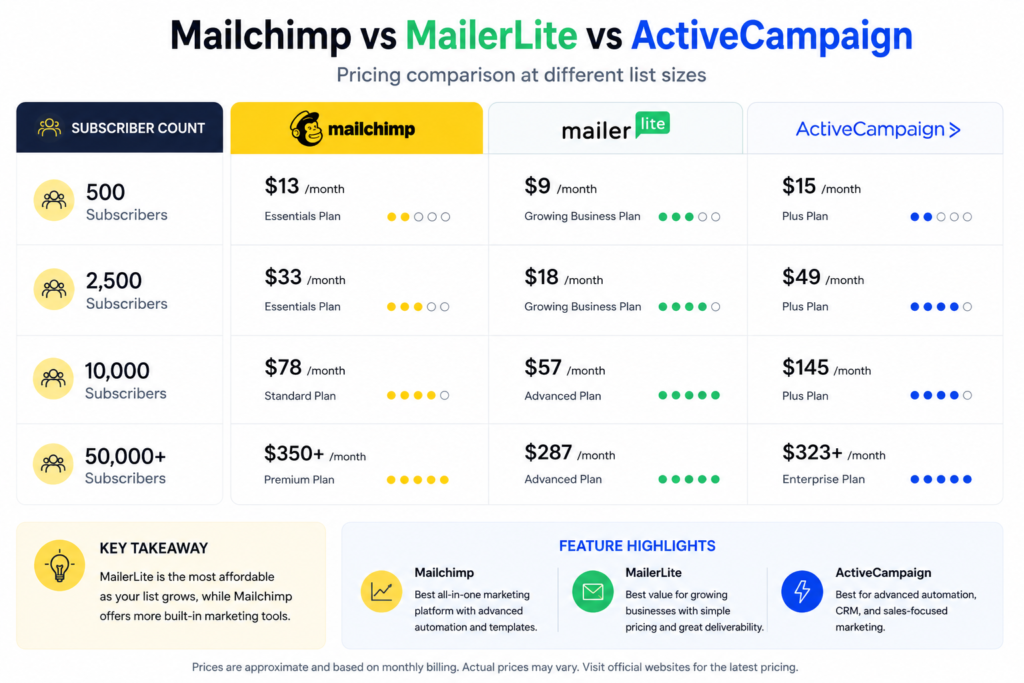
One of the biggest factors affecting Mailchimp Pricing 2026 is subscriber count.
A platform that looks affordable with 500 subscribers may become much more expensive at 10,000 or 50,000 contacts.
That’s why it’s important to compare Mailchimp against alternatives based on the size of your email list not just the advertised starting price.
Small Lists (Under 1,000 Subscribers)
For beginners, Mailchimp remains a strong option thanks to its free plan and beginner-friendly interface.
However, alternatives such as MailerLite and Brevo often provide more features at lower price points for small businesses.
If your budget is limited, it’s worth comparing all three platforms before committing.
Growing Lists (1,000–10,000 Subscribers)
This is where pricing differences become more noticeable.
As subscriber counts increase, Mailchimp’s contact-based pricing can become more expensive than some competitors.
Businesses focused on affordability often compare Mailchimp with MailerLite, Brevo, and ActiveCampaign at this stage.
The right choice depends on whether you value advanced features or lower monthly costs.
Large Lists (10,000–50,000 Subscribers)
For larger audiences, pricing becomes a major consideration.
At this level, even small differences in pricing models can translate into hundreds or thousands of dollars per year.
Many businesses evaluate Mailchimp alongside ActiveCampaign, Klaviyo, and ConvertKit to determine which platform offers the best value for their specific marketing needs.
Enterprise-Level Lists (50,000+ Subscribers)
When managing a large subscriber base, total cost of ownership becomes more important than entry-level pricing.
Features such as advanced automation, segmentation, reporting, and support often have a greater impact on platform selection than the monthly fee alone.
This is where a detailed cost comparison becomes essential.
Price Isn’t the Only Factor
While pricing matters, it shouldn’t be the only reason to choose an email marketing platform.
Also consider:
- Ease of use
- Automation capabilities
- Deliverability
- Reporting features
- Integrations
- Customer support
A cheaper platform isn’t always the best value if it lacks features your business relies on.
Bottom Line
For small lists, Mailchimp is often competitively priced.
As your subscriber count grows, comparing alternatives becomes increasingly important.
The best platform isn’t necessarily the cheapest one it’s the one that delivers the features, scalability, and return on investment your business needs at your current stage of growth.
Is Mailchimp Worth the Cost in 2026?
For many businesses, the answer is yes—but it depends on your goals, subscriber count, and budget.
When evaluating Mailchimp Pricing 2026, the key question isn’t whether Mailchimp is cheap. It’s whether the platform delivers enough value to justify the cost.
Mailchimp Is Worth It If…
Mailchimp remains one of the most beginner-friendly email marketing platforms available.
It combines email marketing, automation, landing pages, website tools, and reporting in a single platform.
For businesses that want an all-in-one solution, this convenience can save both time and money.
Mailchimp may be worth the investment if you:
- Want an easy-to-use platform
- Need marketing automation
- Prefer an all-in-one marketing tool
- Value a large integration ecosystem
- Plan to scale your email marketing efforts
Mailchimp May Not Be Worth It If…
The biggest criticism of Mailchimp is pricing.
As your subscriber count grows, costs can increase faster than many users expect.
Businesses focused primarily on affordability often find that competitors offer similar features at a lower monthly cost.
You may want to compare alternatives if:
- Budget is your top priority
- Your email list is growing rapidly
- You only need basic email marketing features
- You want the lowest possible cost per subscriber
Value Matters More Than Price
A common mistake is choosing an email platform based solely on monthly cost.
In practice, the cheapest platform isn’t always the best value.
A more expensive tool can easily pay for itself if it improves automation, saves time, or generates additional revenue through better email campaigns.
That’s why experienced marketers evaluate return on investment—not just subscription fees.
Our Verdict
After reviewing Mailchimp Pricing 2026, Mailchimp still offers strong value for many small and medium-sized businesses.
The platform is easy to use, feature-rich, and backed by a mature ecosystem.
However, businesses with larger subscriber lists should compare costs carefully before committing long term.
Bottom Line
Mailchimp is worth the cost if you value ease of use, automation, and an all-in-one marketing platform.
If your primary goal is minimizing software expenses, comparing Mailchimp against alternatives is a smart step before making a final decision.
The best choice is the platform that delivers the highest return on investment for your specific business—not necessarily the one with the lowest monthly price.
How to Save Money on Mailchimp
Mailchimp can become expensive as your subscriber list grows, but there are several ways to reduce your costs without sacrificing important features.
If you’re concerned about Mailchimp Pricing 2026, these strategies can help keep your monthly bill under control.
Clean Your Email List Regularly
Mailchimp pricing is largely based on the number of contacts stored in your account.
Removing inactive subscribers can reduce costs and improve email engagement at the same time.
Review your list regularly and remove contacts who haven’t opened or clicked your emails for an extended period.
Choose the Right Plan
Many businesses pay for features they never use.
Before upgrading, make sure the additional tools are necessary for your marketing strategy.
The lowest plan that meets your requirements is usually the most cost-effective option.
Compare Monthly and Annual Billing
Mailchimp offers different billing options.
If you plan to use the platform long term, compare annual and monthly pricing to see which provides better value.
Avoid Unnecessary Add-Ons
Services such as SMS marketing, transactional email, and premium support can increase your total costs.
Only add extra services when they provide clear value for your business.
Monitor Subscriber Growth
Growing your email list is important, but it’s also the biggest factor that increases Mailchimp costs.
Keep an eye on your subscriber count and understand how moving into a higher pricing tier may affect your budget.
Review Alternatives Periodically
As your business grows, your needs may change.
What is affordable today may not be the most cost-effective option a year from now.
Comparing Mailchimp with other email marketing platforms occasionally can help ensure you’re getting the best value.
Bottom Line
The easiest way to save money on Mailchimp is to keep your contact list clean, avoid unnecessary add-ons, and choose the right plan for your current needs.
A few small adjustments can make a significant difference to your total email marketing costs over time.
Frequently Asked Questions About Mailchimp Pricing
How much does Mailchimp cost per month in 2026?
Mailchimp offers several plans, including a Free plan and paid plans that start at a low monthly cost for small contact lists.
Your actual cost depends on your subscriber count, plan type, billing cycle, and any additional services you use.
Does Mailchimp charge based on subscribers?
Yes. Mailchimp primarily uses contact-based pricing.
As your subscriber count grows, your monthly cost can increase even if you continue using the same plan.
Is Mailchimp free to use?
Mailchimp offers a Free plan that allows users to test the platform and build a small email list.
However, advanced features, automation tools, and higher sending limits require a paid subscription.
Why is my Mailchimp bill higher than expected?
The most common reasons include:
Subscriber growth
Moving into a higher contact tier
SMS marketing charges
Transactional email usage
Additional paid features or services
This is why it’s important to calculate your total cost rather than relying on the advertised starting price.
What is the cheapest Mailchimp plan?
The Free plan is the cheapest option because it costs nothing.
For paid plans, Essentials is typically the lowest-priced entry-level subscription.