Omnisend vs Mailchimp Which Tool Dominates in 2026?
Omnisend vs Mailchimp is the most critical comparison you will make for your 2026 marketing strategy, and the right choice depends entirely on your business model. If you are running an e-commerce store and need high-converting omnichannel automation, Omnisend is the superior choice because of its seamless SMS integration and shop-specific features. However, Mailchimp remains the better option for general creators or small businesses that prioritize brand awareness and simple, beautiful newsletter templates.
Our team has spent hundreds of hours stress-testing both platforms in live market conditions to see which one actually drives more revenue. This deep-dive analysis reveals the technical nuances and hidden costs of each tool, ensuring you invest your budget into the platform that scales with your specific growth goals.
Omnisend vs Mailchimp Pricing
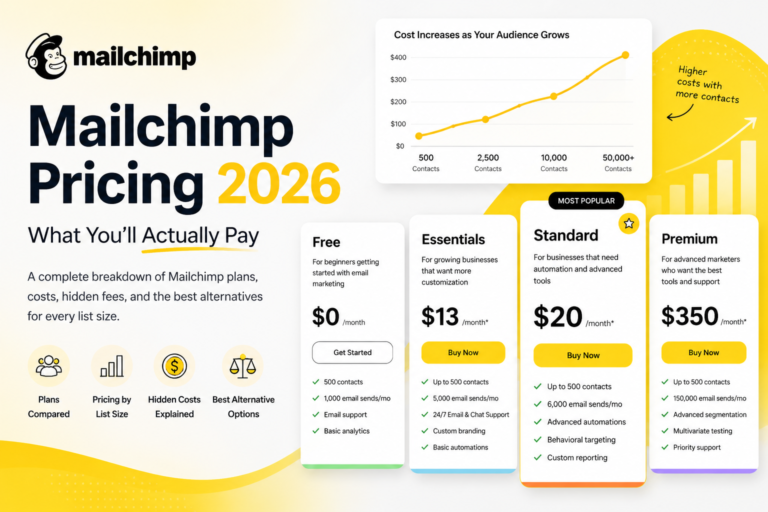
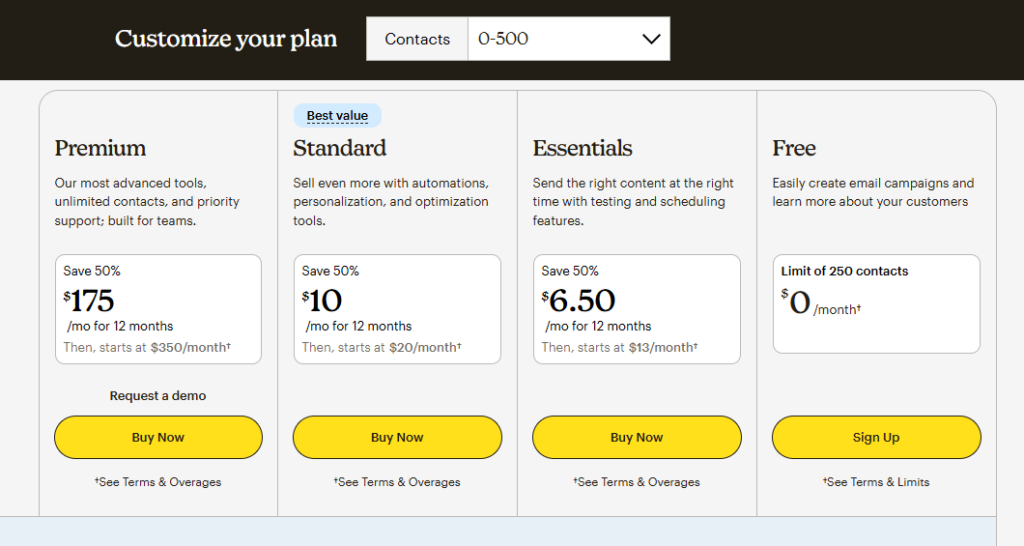
When comparing Omnisend vs Mailchimp pricing, the most expensive mistake you can make is ignoring the “Ghost Tax” hidden in Mailchimp’s billing structure. In 2026, Mailchimp still charges you for every contact in your audience, including unsubscribed and cleaned addresses that you cannot actually email. This means if 20% of your list has opted out, you are essentially paying a 20% premium for dead data. Conversely, the Omnisend vs Mailchimp value gap favors Omnisend for growing brands because they only bill for marketable contacts. While both offer a 250-contact free tier, Omnisend provides full access to its powerful automation workflows for free, whereas Mailchimp gates its most effective journey builders behind a $20/month Standard plan, making the entry-level cost significantly higher for those who need more than just a basic newsletter.
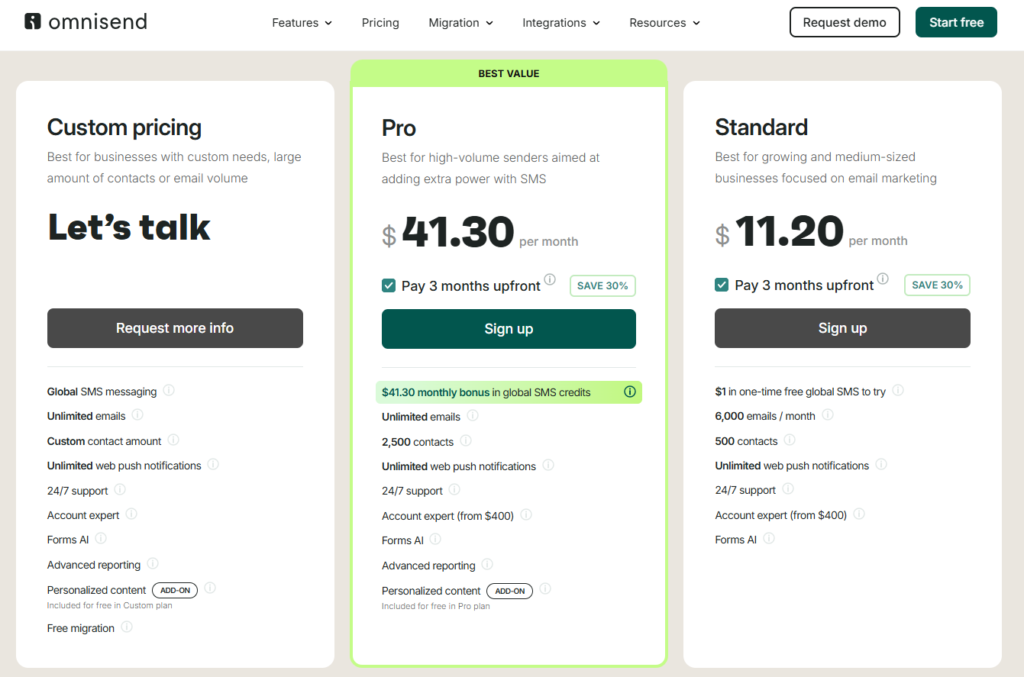
The financial winner in the Omnisend vs Mailchimp debate becomes even clearer as you scale toward high-volume enterprise sending. Omnisend’s Pro plan, starting at $59, includes free SMS credits equal to the monthly subscription price and unlocks unlimited email sends, a massive ROI booster for e-commerce stores during peak seasons like Black Friday. In contrast, the Omnisend vs Mailchimp comparison at the 50,000-contact mark shows Mailchimp’s Premium tier soaring toward $800+ per month, often with strict send limits that can trigger overage charges. For a scaling digital retailer, choosing Omnisend eliminates the need for separate SMS apps and prevents the “success tax” that Mailchimp imposes as your audience grows, ultimately keeping your customer acquisition costs lower and your profit margins higher.
Omnisend Pricing Plans and Contact Limits
Omnisend simplifies scaling by offering three distinct tiers: Free, Standard ($16+), and Pro ($59+). The Omnisend vs Mailchimp advantage here is that even the Free plan unlocks all professional automation features, though it limits your reach to 250 unique contacts per month. High-volume senders find the most value in the Pro plan, which provides unlimited email sends and bundles SMS credits equal to the monthly subscription cost. This “credit-back” system effectively makes the multi-channel strategy free for users who are already paying for high-volume email capacity, a feature Mailchimp struggles to match.
Mailchimp Pricing Tiers and Hidden Costs
Mailchimp’s pricing has become increasingly restrictive in 2026, with a Free tier capped at 250 contacts and only 500 monthly sends. The Omnisend vs Mailchimp gap widens at the $20 Standard tier, where Mailchimp finally unlocks multi-step automations that come standard on all Omnisend plans. Beyond the base price, users often encounter hidden costs through send-limit overages (capped at 10x–12x your contact count) and mandatory add-ons for SMS. For an enterprise-level list of 50,000 contacts, Mailchimp’s Premium plan can exceed $800, making it a significantly higher investment for the same reaching power offered by its competitors.
Omnisend vs Mailchimp E-commerce Automation and Workflows
The battle of Omnisend vs Mailchimp in 2026 is defined by how each platform handles automation logic. While Mailchimp has historically been a general-purpose tool, Omnisend was built specifically for e-commerce, offering one-click “Shopify-native” workflows like abandoned cart and browse abandonment that require zero manual setup. In contrast, the Omnisend vs Mailchimp comparison shows that Mailchimp is catching up with its new “Site Tracking Pixel” and AI-powered Customer Journey Builder, but it still often requires more “if/then” configuration to reach the same level of granular retail targeting that Omnisend provides out of the box.
Abandoned Cart Recovery Performance
When testing Omnisend vs Mailchimp for cart recovery, the biggest differentiator is channel orchestration. Omnisend allows you to drag and drop email, SMS, and push notifications into a single automated branch, ensuring you reach the customer on their preferred device. Mailchimp has improved its 2026 offering with better Shopify syncing, but it still relies heavily on third-party integrations for SMS, which can lead to disjointed data. For high-volume stores, the integrated “quiet hours” and country-specific compliance tools in Omnisend’s workflows make it the safer, more automated choice for global scaling.
Advanced Segmentation for Targeted Sales
The Omnisend vs Mailchimp rivalry is most intense in the area of predictive analytics. Mailchimp’s “Intuit Assist” AI now offers impressive “at-risk” customer spotting and predicted life-cycle stages, which is excellent for general marketing strategy. However, Omnisend focuses on “Event-Level” conditions—allowing you to trigger automations based on specific SKUs, categories, or exact purchase amounts. This level of specificity in the Omnisend vs Mailchimp breakdown means Omnisend users can create more profitable, hyper-personalized upsell paths that directly reference what is currently in the customer’s shopping bag.
Omnisend vs Mailchimp SMS Marketing and Omnichannel Strategy
The Omnisend vs Mailchimp comparison reaches a breaking point when you move beyond simple email and into a true omnichannel strategy. In 2026, Omnisend is widely recognized as the superior choice for high-growth retailers because it allows you to combine email, SMS, and web push notifications into a single, unified workflow. While Mailchimp has introduced SMS marketing as a separate add-on, it still functions largely as a “bolt-on” feature, often requiring different reporting dashboards and separate credit purchases that aren’t as deeply integrated into the customer journey. For a brand looking to recover abandoned carts via text or send time-sensitive shipping updates via push, the seamless drag-and-drop interface of Omnisend provides a level of operational efficiency that Mailchimp’s more fragmented system struggles to match.
The strategic winner in the Omnisend vs Mailchimp omnichannel battle is determined by how well the platforms sync data across these channels to prevent message fatigue. Omnisend’s “Smart Sending” rules automatically ensure that a customer who has already engaged with an email doesn’t receive a redundant (and more expensive) SMS for the same promotion. On the other hand, the Omnisend vs Mailchimp contrast shows that Mailchimp’s multi-channel approach is often more “cross-channel” than “omnichannel,” meaning the platforms talk at the customer rather than with each other. For enterprise-level stores that need to balance global SMS compliance with high-volume sending, Omnisend’s built-in global reach and bundled Pro plan credits offer a more scalable and cost-effective path to total market saturation.
Integrated SMS Features and Global Reach
When evaluating Omnisend vs Mailchimp for international scaling, Omnisend’s built-in SMS capabilities offer an immediate edge with pre-vetted, global sender IDs and automatic compliance handling for different regions. While Mailchimp requires users to navigate a more complex setup for international SMS—often involving third-party credits—Omnisend allows you to start sending texts to over 200 countries immediately. This native integration ensures that your branding remains consistent and your deliverability rates stay high, regardless of where your customers are located.
Push Notifications and Multi-Channel Synergies
A major differentiator in the Omnisend vs Mailchimp debate is the inclusion of web push notifications, a feature that is entirely native to Omnisend but missing from Mailchimp’s core toolkit. Push notifications act as a high-visibility, zero-cost alternative to SMS for re-engaging “window shoppers” and alerting customers to flash sales. By layering push notifications into an automated sequence, Omnisend users can significantly lower their total marketing spend while increasing touchpoints, creating a powerful synergy that Mailchimp’s email-heavy ecosystem simply cannot replicate.
Omnisend vs Mailchimp Ease of Use and User Interface Design
The Omnisend vs Mailchimp user experience is a battle between “e-commerce focus” and “general creative flexibility.” In 2026, Omnisend’s interface is purpose-built for online sellers, featuring a streamlined dashboard that puts product syncing and revenue tracking front and center. While the Omnisend vs Mailchimp learning curve is relatively shallow for both, Omnisend wins on efficiency because its “one-click” integrations with platforms like Shopify mean you spend less time configuring data and more time launching campaigns.
Mailchimp, conversely, offers a more polished, “creative-first” design environment that appeals to users who prioritize aesthetic variety over technical retail features. The Omnisend vs Mailchimp design debate often favors Mailchimp for its superior drag-and-drop editor and “Content Optimizer” AI, which provides real-time feedback on your layouts. However, Mailchimp’s interface has become increasingly cluttered with non-email features (like CRM and Website Building), which can make finding specific e-commerce automation settings feel like a scavenger hunt compared to Omnisend’s cleaner, retail-centric layout.
Onboarding Experience for New Marketers
When comparing Omnisend vs Mailchimp for beginners, Omnisend’s setup wizard is specifically tuned to your store’s URL, automatically pulling in your logo and brand colors to save you hours of design work. Mailchimp also offers a guided onboarding process, but it is broader in scope, asking generic questions about your business goals that may not immediately lead to a live sale. For those wanting to go from “zero to revenue” in under 30 minutes, Omnisend’s pre-built e-commerce templates provide a faster, more intuitive path.
Campaign Builder and Drag-and-Drop Efficiency
The Omnisend vs Mailchimp campaign builder showdown highlights two different philosophies: Omnisend focuses on “Product Pickers” that allow you to drag items directly from your store into an email with live pricing, while Mailchimp excels in visual storytelling. Mailchimp’s editor is arguably more fluid and allows for more complex layout adjustments, but it lacks the native “Discount Code” generators and “Gift Box” elements that make Omnisend’s builder so effective for driving quick conversions. For a busy merchant, the speed of Omnisend’s retail-specific blocks usually outweighs the artistic depth of Mailchimp’s editor.
Omnisend vs Mailchimp Email Templates and Design Flexibility
Gemini said
The Omnisend vs Mailchimp design battle centers on retail efficiency versus creative freedom for modern digital brands. Omnisend’s templates are purpose-built for e-commerce, featuring “Product Pickers” that drag live store items directly into your layout. This specialized approach eliminates manual data entry, allowing merchants to launch high-converting, professional campaigns in a fraction of the time.
While Omnisend focuses on speed, the Omnisend vs Mailchimp comparison highlights Mailchimp’s superior artistic flexibility and AI-driven “Content Optimizer.” Mailchimp offers a vast library of polished, multi-industry themes that cater to influencers and service providers who need deep layout customization. Their advanced drag-and-drop editor remains the gold standard for those prioritizing brand aesthetics over strict retail functionality.
Pre-built E-commerce Themes
Omnisend’s library is strategically limited to high-performance retail layouts that are proven to drive clicks and sales. These themes come pre-loaded with “Gift Box” and “Scratch Card” interactive elements that significantly boost engagement rates. By choosing Omnisend, you bypass the paradox of choice and start with a foundation optimized for the specific psychology of online shoppers.
Custom HTML and Brand Personalization
For developers, the Omnisend vs Mailchimp technical gap is bridged by robust custom HTML editors that allow for bespoke brand experiences. Mailchimp’s environment is slightly more refined for complex coding, offering better previewing tools across various devices and inbox providers. However, Omnisend’s “Brand Assets” feature automatically syncs your store’s colors and fonts, ensuring every custom template remains perfectly on-brand without manual adjustment.
Omnisend vs Mailchimp Shopify and Third-Party Integrations
Gemini said
The Omnisend vs Mailchimp integration battle is won by the platform that connects most deeply to your store’s database. In 2026, Omnisend’s Shopify integration remains the industry gold standard, offering a “one-click” sync that imports your entire product catalog, historical data, and discount codes in seconds. While Mailchimp has restored its native Shopify app, it still functions as a secondary layer, often requiring additional syncing time to reflect real-time inventory changes.
Choosing between Omnisend vs Mailchimp for third-party tools depends on whether you want a specialized retail stack or a general marketing ecosystem. Mailchimp’s massive app marketplace offers thousands of connections for everything from real estate CRMs to non-profit donation tools, making it the most versatile choice for non-retailers. However, Omnisend’s integration library is curated specifically for e-commerce, focusing on high-performance loyalty programs, shipping updates, and review platforms like Yotpo or Okendo.
Native App Support and One-Click Syncing
Omnisend’s native Shopify and BigCommerce apps are built to handle high-volume data transfers without the lag often seen in multi-purpose platforms. This tight integration allows for “Product Pickers” that let you drag live store items directly into your emails with automatic pricing and image syncing. Mailchimp’s native apps have improved, but they still lack the deep-level SKU tracking that allows for the hyper-granular automation triggers found in the Omnisend ecosystem.
API Capabilities for Custom Tech Stacks
For developers building bespoke headless commerce sites, the Omnisend vs Mailchimp API comparison reveals two very different philosophies. Mailchimp offers a robust, well-documented API that is designed for broad flexibility across almost any web application or custom-coded platform. Conversely, Omnisend’s API is laser-focused on “event-driven” retail data, making it the superior choice for developers who need to pass complex purchase data and custom checkout events back into their marketing workflows.
Omnisend vs Mailchimp Customer Support and Expert Assistance
Gemini said
The Omnisend vs Mailchimp support experience is a major deciding factor for 2026 merchants who cannot afford downtime. Omnisend takes a “support-for-all” approach, offering 24/7 live chat and email assistance to every user, including those on the free plan. In the Omnisend vs Mailchimp comparison, Mailchimp is notably more restrictive, gating live chat behind paid tiers and limiting free users to only 30 days of email support, which can leave startups stranded during critical growth phases.
For high-volume brands, the Omnisend vs Mailchimp expert assistance gap is defined by how quickly you get a human on the line. Omnisend boasts an average response time of under 4 minutes and provides a dedicated Customer Success Manager once you hit a $400/month spend threshold. Mailchimp also offers premium support and phone assistance, but this is reserved for their highest-priced Premium tier, often requiring a much larger list size and budget before you receive that same level of personalized, one-on-one strategic guidance.
24/7 Availability and Response Times
Omnisend’s commitment to 24/7/365 availability ensures that global e-commerce stores get technical help regardless of their time zone or plan level. Their support team is highly rated for technical retail knowledge, specifically helping with API pulls and Shopify-syncing errors that often plague online sellers. Mailchimp’s response times are generally reliable for paid users, but the lack of a permanent support lifeline for free accounts makes it a riskier choice for those testing the waters of email marketing.
Dedicated Account Managers and Documentation
The Omnisend vs Mailchimp comparison for enterprise users favors Omnisend’s lower barrier to entry for “White Glove” service. While Mailchimp provides an extensive library of self-help articles and AI-driven troubleshooting, their dedicated account management is typically reserved for massive lists of 500,000+ contacts. Omnisend’s experts are more accessible to mid-market brands, offering proactive audits and workflow optimizations that help smaller teams compete with industry giants without the enterprise-level price tag.
Final Verdict: Omnisend vs Mailchimp – Which Platform Wins in 2026?
The Omnisend vs Mailchimp verdict in 2026 depends entirely on your business model: Omnisend is the undisputed winner for e-commerce, while Mailchimp remains the stronger choice for general brand building. If your primary goal is to drive sales through a Shopify, BigCommerce, or WooCommerce store, Omnisend’s retail-specific tools—like one-click product insertion and bundled SMS—provide a direct path to higher ROI. However, for bloggers, service providers, or creative agencies who need a versatile marketing hub with superior design flexibility and AI-driven content advice, Mailchimp’s broader ecosystem and high deliverability reputation still hold the crown.
Ultimately, the Omnisend vs Mailchimp choice comes down to how you value your growth and your time. Omnisend’s transparent pricing and open access to advanced automation on all plans make it the most scalable partner for merchants who want to avoid the “success tax” of hidden contact costs. Mailchimp is the better all-purpose tool for those who prioritize a polished aesthetic and need a platform that integrates with a vast array of non-retail third-party apps. For a modern digital storefront, the specialized, sales-first infrastructure of Omnisend simply delivers more functional power for every dollar spent.
| Feature | Omnisend (2026) | Mailchimp (2026) |
| Best For | Dedicated E-commerce Stores | General Brands & Bloggers |
| Automation | Full access on all plans | Gated behind $20+ plans |
| Billable Contacts | Reachable subscribers only | All contacts (even unsubscribed) |
| SMS Marketing | Built-in (credits included in Pro) | Separate add-on / segmented |
| Support | 24/7 Live Chat for everyone | Gated for paid users only |
| Primary Edge | Retail-specific efficiency | Creative design & AI insights |
CONCULTION
The Omnisend vs Mailchimp debate in 2026 is clearly divided by business intent: choose Omnisend for high-conversion e-commerce and Mailchimp for general brand awareness. Omnisend wins on value by offering all automation features for free and only billing for reachable subscribers, saving you from the “ghost tax” of paying for unsubscribed contacts.
For scaling brands, the Omnisend vs Mailchimp choice is about integrated power versus broad flexibility. While Mailchimp offers a polished creative suite for various industries, Omnisend’s built-in SMS credits and “one-click” Shopify workflows provide a faster, more cost-effective path to revenue for online retailers.
FAQ
Is Omnisend better than Mailchimp for Shopify stores in 2026?
Yes, for most e-commerce merchants, Omnisend is the superior choice because it was built specifically for retail.
Does Mailchimp charge for unsubscribed contacts?
One of the biggest hidden costs in the Omnisend vs Mailchimp debate is Mailchimp’s “Ghost Tax.” In 2026, Mailchimp still counts unsubscribed and cleaned contacts toward your monthly billing limit unless you manually archive them. Omnisend, however, only charges you for reachable, marketable subscribers.
Can I send SMS through both Omnisend and Mailchimp?
Both platforms support SMS, but the Omnisend vs Mailchimp experience differs in how these messages are integrated.